How Children Learn to Speak and Why Flashcards Boost Language Learning
Repetition, meaningful context, and playful routines explain both first-language acquisition and why visual cards are so effective for early second-language learning.
The process by which a child learns to speak is one of the most fascinating phenomena in human development. From early babbling to complete sentences, each stage reflects the remarkable ability of the child’s brain to absorb, process, and reproduce linguistic information. What is most striking is that this learning occurs naturally, without formal instruction, through constant interaction with the environment.
One of the fundamental principles of this process is repetition. When a baby repeatedly hears the name of an object—“ball,” “mama,” “water”—the child begins to establish an association between the sound of the word and the corresponding object or action. With each repetition, neural connections are strengthened, making memorization and oral production easier.
This mechanism not only explains how we acquire our mother tongue but also forms the foundation of the most effective methods for teaching a second or third language from an early age.
The Power of Naming: Repetition and Memory
A one-year-old child may already point to an object when asked, even if they are not yet able to pronounce the word. This happens because language comprehension develops before verbal production. The key is constant exposure: the more often a word is heard in a clear context, the faster it is internalized.
Here lies the importance of systematic repetition. Far from being boring or mechanical, repetition is the brain’s natural tool for consolidating learning. Every time an adult names an object in front of a child, the link between word and meaning grows stronger.
Flashcards: Bridging Natural and Structured Learning
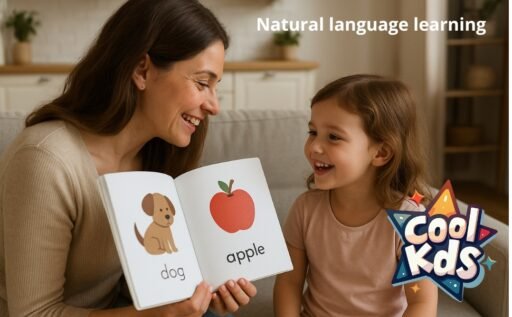
Flashcards (visual cards with images and words) have become a highly effective educational resource because they replicate this natural process of learning in a structured way.
- Visual and auditory stimulation: showing an image while pronouncing the word engages two channels of input, increasing retention.
- Contextualized repetition: revisiting the cards in different sessions reinforces long-term memory.
- Playful motivation: flashcards transform repetition into a fun and engaging dynamic that holds a child’s attention.
- Multisensory learning: children can see, hear, point, and repeat, activating different brain areas simultaneously.
Research in pedagogy and neuroscience has shown that multisensory learning accelerates vocabulary acquisition and makes it easier to transfer knowledge to real-life situations.

Why Are They Key for a Second Language?
When it comes to learning a second or third language, the challenge is even greater, as children must build new associations not directly linked to their mother tongue. This is where flashcards become invaluable because they provide immediate context with images, foster immersion by using the target language directly (“apple” instead of “manzana”), and organize vocabulary into categories such as animals, colors, or household objects.
Flashcards also adapt well to different ages— from toddlers to older learners— since they can be used in memory games, group activities, or even independent practice.
Practical Tips for Using Flashcards at Home
- Consistency: dedicate 5–10 minutes daily to flashcard activities. Regularity is more effective than long, infrequent sessions.
- Game variety: alternate between showing and naming, asking the child to point, hiding and revealing, or using the cards to tell short stories.
- Positive repetition: avoid harsh corrections. Motivation and encouragement are key.
- Active participation: invite the child to handle the cards, organize them, or even create their own drawings.
- Natural immersion: connect flashcards to real-life moments—if the card shows “milk,” also point to the glass of milk on the table.
Conclusion
Language acquisition is a natural process, but it can be greatly enhanced with the right pedagogical strategies. Repetition, the cornerstone of linguistic development, finds in flashcards a practical, playful, and effective tool to introduce children to a second or even third language.
As educators, we know that what truly matters is not the number of words memorized in a short period but the quality of the associations the child builds. Every card shown, every word repeated, and every smile of success is part of a journey that opens the doors to multilingualism and to the child’s overall growth.
✨ Inspire learning through stories, coloring & play.
At CoolKDS.com, we create fun and educational multilingual books that help children grow with confidence and creativity.